
Colonial-era Lake George
Why the Land Tortoise Was Sunk in Lake George in 1758
Published: · 4 min read
Prepared and first published . About these dates
The Land Tortoise was deliberately sunk in Lake George in October 1758 so it could be used again. British-led forces meant to protect the floating gun battery from French-led attacks through the winter. Recovery never followed, and the vessel remained unlocated until a sonar discovery in . Its history connects a military storage plan with a much later effort to survey and protect the surviving wreck. [3] [2]
Shipbuilding after the defeat at Carillon
The destruction of Fort William Henry in 1757 preceded another British attempt to take the French forts to the north. In July 1758, Major General James Abercromby's army suffered a defeat at Fort Carillon, now Ticonderoga, and returned to southern Lake George. The Battlefield Park's visitor-center account describes extensive building there afterward, including a protected shipyard and new vessels for another campaign. [1]
That sequence places the Land Tortoise after the July battle. The autumn sinking belonged to preparations for a future return to the lake. It was a deliberate decision about protecting equipment when the campaigning season ended. [1] [3]
A seven-sided floating gun battery
A radeau was a raft-like artillery vessel. The Land Tortoise was built by provincial forces under Captain Samuel Cobb of Falmouth, now Portland, Maine. New York Almanack's account describes construction taking just over a month, followed by launching and a rowing test. [2]
The museum panel describes a seven-sided vessel, 52 feet long, propelled by 26 oars and designed for two masts with square sails and seven heavy cannons. Those are specifications for an artillery platform. They should not be read as an inventory of weapons found on the wreck or proof that every planned fitting was aboard when it sank. [1]
October 1758: sinking the boat for safekeeping
Without a strong winter garrison at the lake, the British faced the problem of protecting their new buildings and watercraft. The park's account describes buildings being dismantled and vessels being removed or sunk for later retrieval. The Land Tortoise was part of that response. [1]
Joseph W. Zarzynski, a member of the discovery team, explained the purpose in his abstract for the 1992 Council for Northeast Historical Archaeology conference: British-led forces sank the radeau to protect it from French-led forces. New York Almanack supplies the other half of the plan, the intended refloating in spring . Underwater storage was supposed to preserve a useful vessel for the following season. [3] [2]
The plan failed because the radeau settled too deep to recover. Almanack describes a depth of about 100 feet; the museum panel gives 107 feet. The difference between an intended temporary sinking and an unrecovered wreck explains why this particular boat survived to become an archaeological site. [2] [1]
From a sonar discovery to an archaeological survey
Zarzynski's conference abstract dates the side-scan sonar discovery to . An archaeological diving team located the intact warship, then notified New York State authorities. This participant account gives a dated sequence beyond the more general statement that the boat was found in 1990. [3]
A permit for archaeological survey followed in . During 1991 and 1992, volunteer archaeological divers worked under the direction of two archaeologists. The abstract identifies Zarzynski with Bateaux Below, Inc., and describes the Land Tortoise Radeau Survey's effort to obtain historic-register recognition. Discovery, authorized survey and nomination were separate stages. [3]
The source used here is the complete conference abstract, available through indexed text, rather than the project's full technical report. It documents the survey's existence and organization without supplying a complete catalog of its findings. The park panel's description of the vessel as the oldest intact warship in North America belongs to its interpretation of that surviving boat. [3] [1]
Two federal recognition dates
The National Park Service's official 1995 weekly-list compilation records the LAND TORTOISE (radeau) Shipwreck Site in Warren County as listed on , with identification number 95000819. This is its National Register of Historic Places listing. [4]
A separate entry in the 1998 compilation records National Historic Landmark designation on . Keeping these dates separate preserves the chronology from the 1990 discovery, through survey and nomination, to successive forms of recognition. Neither date is the year the vessel was found. [5]
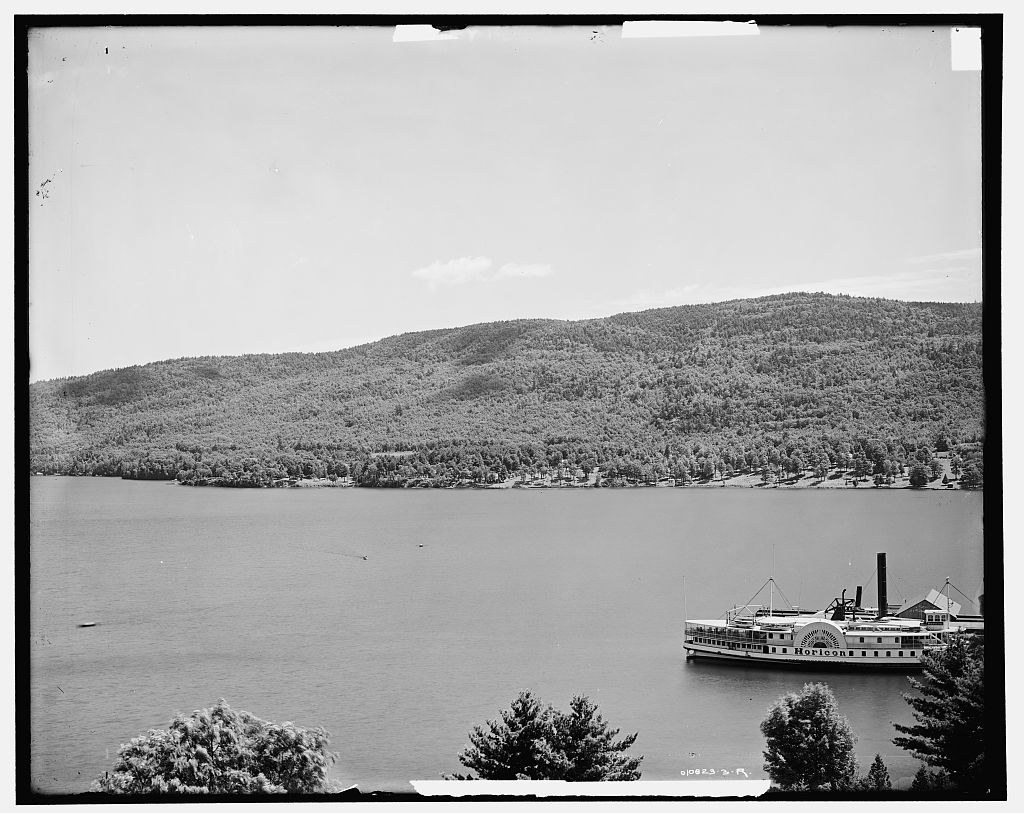
The photograph above shows a later Lake George landscape and the steamer Horicon, from a Library of Congress record dated 1905. It provides regional context. The eighteenth-century vessel discussed here is the underwater radeau, whose identity and survey history are documented in the archaeological account. [6] [3]
Sources and archived records
- Lake George Battlefield Park Alliance: 1758, Aftermath of a Failed Expedition2022 Visitor Center panels, complete page 5; campaign, shipbuilding and sinking; downloaded and read November 11, 2026. Checked November 11, 2026.
- New York Almanack: Lake George’s 1758 Land Tortoise ShipwreckAugust 26, 2025 historical account and introduction to a Russell P. Bellico interview; article read November 11, 2026; podcast not independently listened to. Checked November 11, 2026.
- Joseph W. Zarzynski: The Lake George Land Tortoise Radeau, Discovery, Survey and Nominating the Site1992 Council for Northeast Historical Archaeology conference program, Session 6; complete relevant indexed abstract read November 11, 2026, not the full technical report. Checked November 11, 2026.
- National Park Service: National Register of Historic Places, 1995 Weekly ListsWarren County entry, NRIS 95000819, listing July 10, 1995; downloaded and checked November 11, 2026. Checked November 11, 2026.
- National Park Service: National Register of Historic Places, 1998 Weekly ListsWarren County entry, NRIS 95000819, National Historic Landmark designation August 5, 1998; downloaded and checked November 11, 2026. Checked November 11, 2026.
- Library of Congress: Lake George from Fort William Henry HotelDetroit Publishing Co., c1905; three-negative panorama, right section det.4a06724; catalog and image checked November 11, 2026. Checked November 11, 2026.