
Steamboats and rail connections
Lake George Steamboats: From 1817 to Train Connections
Published: · 5 min read
Prepared and first published . About these dates
Lake George steamboat history begins with the James Caldwell in , but the boats' importance extended beyond the voyage itself. They carried people and goods between lakeside communities, then became part of a route linking trains at both ends of the lake. An advertised schedule for shows how a traveler could step from a southbound steamer onto a train for Saratoga, Albany or New York. [1] [2] [4]
1817: the James Caldwell and a working lake route
The Lake George Steamboat Company dates its incorporation by the New York State Legislature to . Its first vessel, the James Caldwell, entered service that year. The operator's history describes a wooden hull and an end-to-end trip taking about eight hours. This was an early steam-powered service, well before the railroad reached the southern lakeshore. [1]
County tourism writer Eric Pfau describes the company's first business as transporting people and goods. Lake George Village, then known as Caldwell, was one end of a water route extending north toward Ticonderoga. Moving supplies along that route served communities as well as visitors. The later fame of excursion cruises can obscure this practical role in regional transportation. [2] [3]
The railroad reached Caldwell in 1882
After the Civil War, the steamboat operation became part of the Delaware and Hudson transportation system. Warren County's history of the Caldwell branch dates construction of the extension from Glens Falls to Lake George to and the arrival of trains at Caldwell to late May . The operator's account confirms the branch's 1882 opening. Rail passengers could now arrive at the southern end of the lake and continue by boat. [3] [1]
The county account describes June-through-September journeys from points south to the steamer pier. Boats stopped at lakeshore hotels. Some passengers came for a day's sightseeing; others brought trunks and equipment for a summer stay. The dock was therefore both a transfer point and a gateway to accommodations farther along the shore. [3]
Reading the train-to-steamer connections in 1887
A timetable preserved in S. R. Stoddard's Lake George (Illustrated) and Lake Champlain: A Book of To-Day makes the arrangement concrete. The scanned eighteenth edition has an 1888 copyright, while this schedule is explicitly headed "Season of 1887." Its times belong to that advertised season. They are not a present-day cruise schedule or a record proving that every departure ran on time. [4]
| Steamer | Departure and direction | Connection described |
|---|---|---|
| Horicon, Captain Manville | Caldwell, 9:40 a.m., toward Baldwin via intermediate landings | After the train from Saratoga and the south; onward train for Lake Champlain at Baldwin |
| Horicon | Baldwin, 1 p.m., toward Caldwell | Return toward Caldwell and the south |
| Ticonderoga, Captain Arbuckle | Baldwin, 7:30 a.m., toward Caldwell via intermediate landings | Train for Saratoga, Albany and New York |
| Ticonderoga | Caldwell, 4:30 p.m., toward Baldwin | Departure after the train's arrival |
Baldwin was the northern Lake George transfer point near Ticonderoga. The timetable's "way landings" meant stops between the terminals. Its repeated references to arriving trains show coordinated journeys: the lake crossing was one leg of a longer trip. [4] [1]
On the same page, the Lake Champlain steamer Vermont is scheduled between Plattsburgh, Port Kent, Burlington and Fort Ticonderoga, with connections to trains serving Lake George. The two lakes were joined in the passenger itinerary by rail. The page also advertises meals aboard the Lake George boats, another detail of how passengers spent their traveling day. [4]
The surviving station came later, from 1909 to 1911
The railroad's arrival and the construction of the familiar station were different events.
The National Register's account of the Delaware and Hudson Passenger Station dates the replacement building to the period from to . It replaced a station erected in 1882 and continued to serve the company's railway and steamboat operations. [5]
Ludlow & Peabody designed the Mediterranean Revival station while working on the replacement Fort William Henry Hotel, whose predecessor burned in June 1909. The National Register describes the buildings as complementary parts of a transportation and resort complex. Two long covered platforms once extended from the station's concourse. Architecture, hotel accommodation and the boat connection were planned together at this lakeside terminus. [5]
The Sagamore in a period photograph
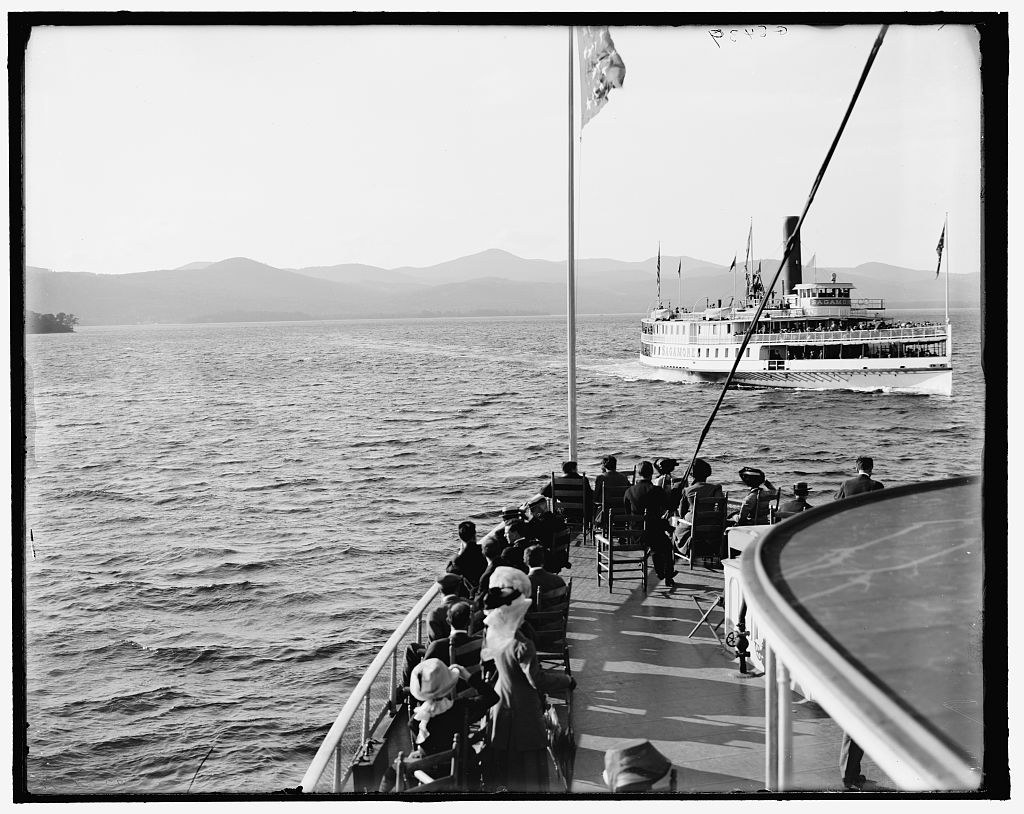
The photograph above belongs to the later steamboat era. The approaching vessel is marked Sagamore, and the Library of Congress catalogs the view as taken between and . Passengers occupy the foreground boat's open deck. The image records the experience of passing another passenger vessel; it does not identify the foreground boat or document a particular train connection. [7]
The Mariners' Museum catalog identifies the Sagamore as a 1902 side-wheel steamer and records a 1901 steel-hull specification for the vessel. That catalog entry establishes the identity of the document, not a reading of its engineering details. Alongside the operator's description of the early wooden James Caldwell, it marks a change in the vessels serving this route. [8] [1]
Reused names can hide different boats
The Minne-Ha-Ha offers a useful warning when reading fleet histories. Anthony F. Hall's anniversary report in the Lake George Mirror distinguishes the first vessel, a side-wheel steamer operated from 1857 through 1877, from the later stern-wheel excursion boat. [6]
The latter was christened on , and began daily service on . Those are two different milestones for a different boat. [6]
Hall's account explains that the later vessel was intended for short cruises in the southern basin. Its purpose helps distinguish an excursion designed around time aboard from the through journeys in the 1887 timetable. For another part of the county's transportation history, the Warren County Bikeway bridge account follows construction along a corridor given a later recreational use. [6]
Sources and archived records
- Lake George Steamboat Company: Press Information and Company HistoryOperator history: incorporation on April 15, 1817, the James Caldwell and later railroad connections.. Checked November 13, 2026.
- Eric Pfau, Lake George Area: Sherpas of the LakeUpdated April 11, 2025. County tourism history describes the early transport of people and goods.. Checked November 13, 2026.
- Warren County Planning Department: History of the Caldwell Branch of the RailroadPublished August 2021 by Warren County Planning, with town and county historians. Caldwell branch construction and summer passenger transfers.. Checked November 13, 2026.
- S. R. Stoddard: Lake George (Illustrated) and Lake Champlain, eighteenth edition1888 copyright, eighteenth edition. The complete timetable on PDF page 159 is explicitly headed Season of 1887.. Checked November 13, 2026.
- National Register of Historic Places: Delaware & Hudson Passenger StationOfficial National Register description, reference 13000310. Replacement station built from 1909 to 1911; earlier station and hotel complex.. Checked November 13, 2026.
- Anthony F. Hall, Lake George Mirror: Look Who’s Fifty, Celebrating the Launch of the Minne-Ha-HaJuly 21, 2019. Anniversary reporting distinguishes the nineteenth-century namesake from the boat christened in July 1969.. Checked November 13, 2026.
- Library of Congress: Lake George, N.Y., passing boatsDetroit Publishing Co., between 1900 and 1920; digital image det.4a25309. Exact camera date unknown.. Checked November 13, 2026.
- The Mariners’ Museum: Specification of a steel hull for service on Lake GeorgeBibliographic record for a 1901 steel-hull specification; completed vessel identified as Sagamore, a 1902 side-wheel steamer. The underlying specification is not reproduced in the catalog.. Checked November 13, 2026.