
Colonial-era Lake George
The Battle of Lake George: Three Engagements in One Day
Published: · 4 min read
Prepared and first published . About these dates
On , fighting moved along the military road south of Lake George, reached the camp at the lake and continued in another encounter later that day. New York's battlefield guide treats these as three engagements within the Battle of Lake George: the Bloody Morning Scout, the Battle at the Lake and the Skirmish at Bloody Pond. [1]
Toward Crown Point along the military road
William Johnson's assignment was to lead colonial troops and Native allies against the French stronghold at Crown Point on Lake Champlain. His force was encamped at Lake George when the French attacked. The National Park Service's biography places that expedition within Johnson's dual role as a provincial military commander and the British superintendent of Indian affairs in 1755. [2]
Johnson's strongest relationships within the Six Nations were with the Mohawks, according to the NPS account. Its discussion of his influence provides context for the expedition's combination of provincial soldiers and Mohawk allies. [2]
The military road connected the lake camp with Fort Lyman, later known as Fort Edward. Historian Russell P. Bellico's study describes a southbound detachment sent to reinforce that fort on the morning of the battle. [4]
The Bloody Morning Scout and the retreat
Colonel Ephraim Williams led provincial troops along the road, accompanied by Mohawk warriors under Hendrick, also known as Theyanoguin. They encountered an ambush set by Jean-Armand Dieskau's force. The movement intended to support the southern post became the first engagement of the day. [4]
A letter described by the Newport Historical Society offers a closer view of the retreat. Dated September 16, 1755, it is believed to be a contemporary copy of Edward Cole's firsthand account. In the society's summary, Cole tried to rally the retreating men but also had to withdraw under French pressure. Williams and Hendrick were among those killed. [3]
The retreat carried the fighting back toward the main body at Lake George. This is the connection between the morning action on the road and the defense at the lake, rather than a second name for the same engagement.
A defense at the lake changed the outcome
Cole's account, as summarized by the historical society, describes his men joining Johnson's main force and making a stand. It ends with the withdrawing French being overtaken by troops from New Hampshire. The letter's sequence preserves movement through the day's fighting, even though it is one participant's account rather than a complete view of every position. [3]
Johnson was wounded during the battle, but the outcome favored his force. The NPS biography identifies the engagement as a British victory, while DEC's guide connects that success with Johnson's subsequent construction of Fort William Henry. That fort belongs to the aftermath of the 1755 battle. The French siege of it in 1757 was a later campaign. [2] [1]
Late-day fighting and the Bloody Pond story
Bellico describes reinforcements moving north from Fort Lyman after the main battle. They met a French-allied force along the military road, producing the third engagement. New Hampshire and New York troops fought Canadians and Indigenous warriors. [4]
The familiar story that bodies thrown into a pond turned its water red needs to be distinguished from testimony about the fighting. In his Winter 2024 study, Bellico notes that the participant accounts he examines do not describe burial parties throwing bodies into the pond. He follows the story through later retellings and discusses disagreements about the pond's location. [4]
A later monument above the battlefield
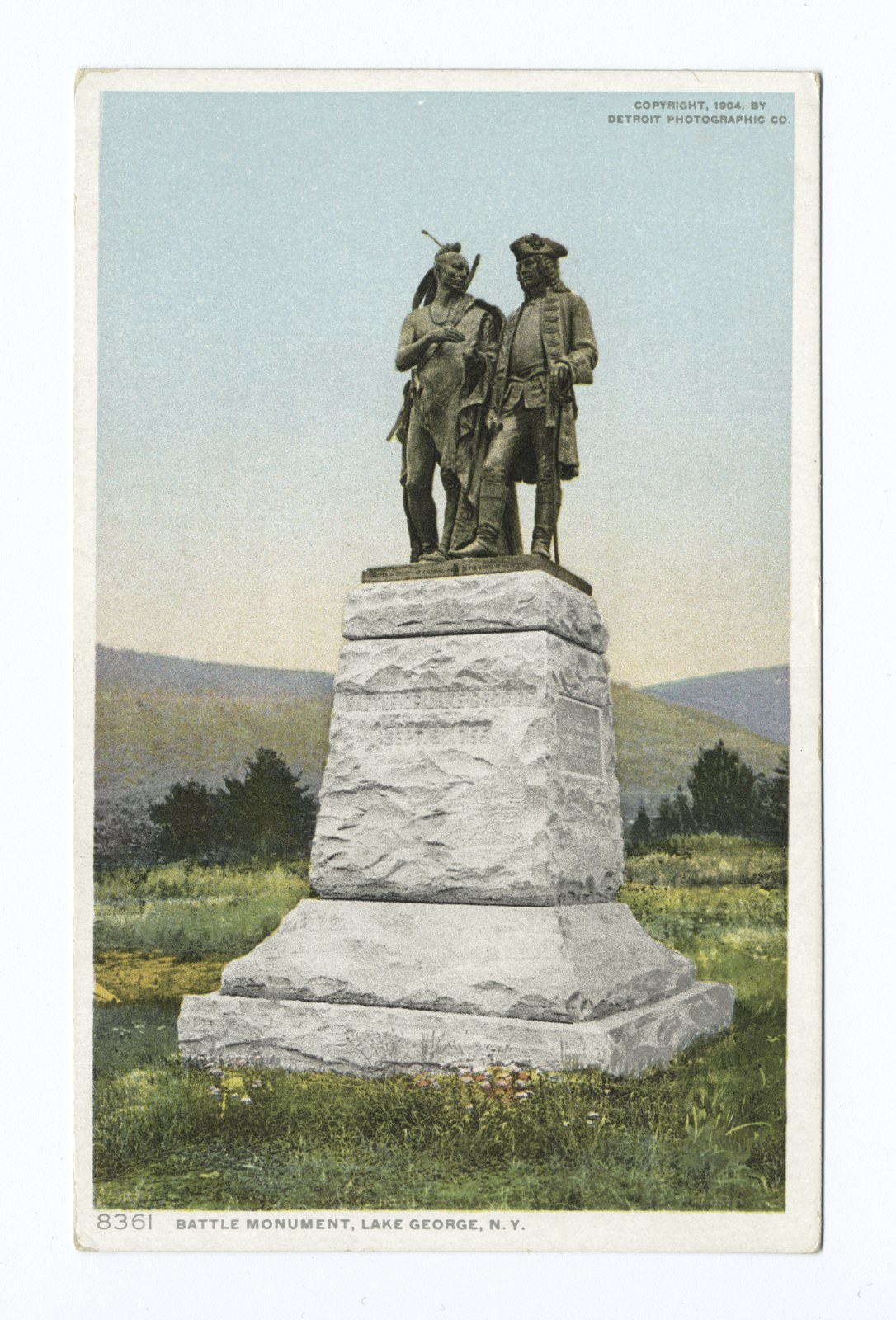
The postcard reproduced here shows the memorial to William Johnson and Hendrick, which DEC dates to . Its two figures belong to the park's commemoration of the battle. The postcard bears a copyright line from the Detroit Photographic Company; the exact date of the underlying photograph is not recorded here. [1] [5]
DEC identifies Fort George Road as closely following Johnson's military road and describes the high ground near the park entrance kiosk as the likely location of the main engagement. The word likely matters when relating today's landscape to eighteenth-century positions. [1]
All of this preceded the creation of Warren County in 1813. The battle, the later memorial and the county's founding each left a different layer of local history: a day's fighting, a commemorative landscape and a new unit of government.
Sources and archived records
- New York State DEC: Tour Lake George Battlefield ParkSelf-guided interpretive tour; pages 1-2, battle sequence, military road and memorial. Checked November 6, 2026.
- National Park Service: Sir William JohnsonHistorical biography, updated October 15, 2024; 1755 campaign. Checked November 6, 2026.
- Newport Historical Society: Colonel Edward Cole's Account of the Battle of Lake GeorgeJune 16, 2017; society description of a letter dated September 16, 1755, believed to be a contemporary copy. Checked November 6, 2026.
- Russell P. Bellico: Bloody Pond, Fort George Post, Winter 2024Lake George Battlefield Park Alliance newsletter, pages 6-14; sourced historical study. Checked November 6, 2026.
- Battle Monument (front), Lake George, N. Y.: NYPL scan via Wikimedia CommonsPhotographic postcard bearing a 1904 copyright imprint; original camera date unknown; public-domain scan. Checked November 6, 2026.