
Colonial-era Lake George
Fort William Henry in 1757: The Siege and the Surrender Terms
Published: · 5 min read
Prepared and first published . About these dates
The siege of Fort William Henry ended with a promise of protected withdrawal. On , Lieutenant Colonel George Monro surrendered the British post at the southern end of Lake George to Louis-Joseph de Montcalm. The capitulation covered both the fort and an adjoining entrenched camp. Its terms allowed the defenders to leave for Fort Edward, but violence against soldiers and camp followers followed the agreement. [1] [5]
The fort and the entrenched camp
Fort William Henry belonged to the military landscape created after the Battle of Lake George in 1755. New York's Department of Environmental Conservation connects its construction with William Johnson's victory that year. The siege two years later was a separate campaign in the French and Indian War. [2]
The fort could accommodate about 500 soldiers. Most of Monro's force occupied a separate camp on higher ground east of it, within today's Lake George Battlefield Park. The park's visitor-center panel describes a log breastwork following the hillside and identifies British engineer James Montresor with its design. This explains why an account confined to the fort's walls misses much of the defended position. [3]
Monro commanded the 35th Regiment of Foot as well as the wider force at the lake. His name also appears as Munro in historical writing. The opposing army combined French regulars, Canadian militia and Indigenous warriors from several nations. General Daniel Webb, at Fort Edward, was the British commander from whom relief was sought. [3] [1]
August 3 to 9: artillery and the failure of relief
The American Battlefield Trust dates the siege from through August 9. Montcalm's force arrived by water with artillery, then brought its guns closer to the British defenses. The Trust describes bombardment damaging the walls and disabling guns as the French positions advanced. [1]
Monro requested reinforcements, but Webb declined to send further troops. A captured message from Webb recommending surrender reached Montcalm, who shared it with Monro. The defenders faced both a deteriorating position and the loss of hope for relief. The resulting agreement was a negotiated capitulation with obligations on each side. [1]
What the nine surrender articles promised
The Lake George Examiner published a complete transcription of the nine articles when reporting the museum's 2017 surrender commemoration. The document is dated August 9, 1757, at noon. Its clauses distinguish personal property, military supplies and arrangements for people unable to march. [5]
- Departure and escort: The combined fort and camp garrison could leave with arms, officers' and soldiers' baggage and the honors of war, including drums and colors. French troops, officers and interpreters were to escort them to Fort Edward early the next morning.
- Handover: The French received the fort gate after signature and the camp after departure. Artillery, stores and provisions required an inventory. A final clause allowed Monro one six-pounder cannon.
- Service: The garrison could not serve against France or its allies for eighteen months. A return identifying the troops was required.
- Hostage: One officer would remain until the French escort returned.
- Care and food: Montcalm was to protect those too sick or wounded to travel and return them after recovery. Provisions were authorized for the day of surrender and the following day.
These provisions come from Articles I through IV and VI through IX; the Potawatomi center also describes the honors of war. [5] [4]
Article V also required the return of captives to Carillon, now Ticonderoga, within three months. The Citizen Potawatomi Nation Cultural Heritage Center's account stresses that the people to be returned included French officers and soldiers, Canadians, women and Native captives. The transcription links that return to permission for an equivalent number of men to serve again. The agreement therefore dealt with earlier captivity as well as the immediate evacuation. [4] [5]
August 10: the promised march broke down
Surrender did not bring immediate safety. The Battlefield Park's 1757 panel describes warriors entering and looting the entrenched camp on August 9. On , as the column left, men at its rear were stripped and attacked. The camp was a central setting for this violence, which continued into the departure toward Fort Edward. [3]
The American Battlefield Trust also records attacks on the sick and wounded and the taking of captives. It notes that estimates of British losses varied widely and that the role of French officers was controversial. A count of people missing immediately afterward cannot simply be treated as a count of deaths: captivity was also part of the outcome. [1]
The episode is commonly called the Fort William Henry massacre. The Potawatomi center identifies the attacks as a violation of the surrender terms. Its account also identifies warriors from multiple Native nations in the French-allied force. That distinction matters: these summaries do not establish one motive or a uniform decision by every nation represented. [4]
The old fort site before the reconstruction
The French destroyed Fort William Henry after the surrender and withdrew, according to DEC's guide. The fort standing today is a twentieth-century reconstruction on the original site. The Center for Land Use Interpretation places that rebuilding in the 1950s. [2] [6]
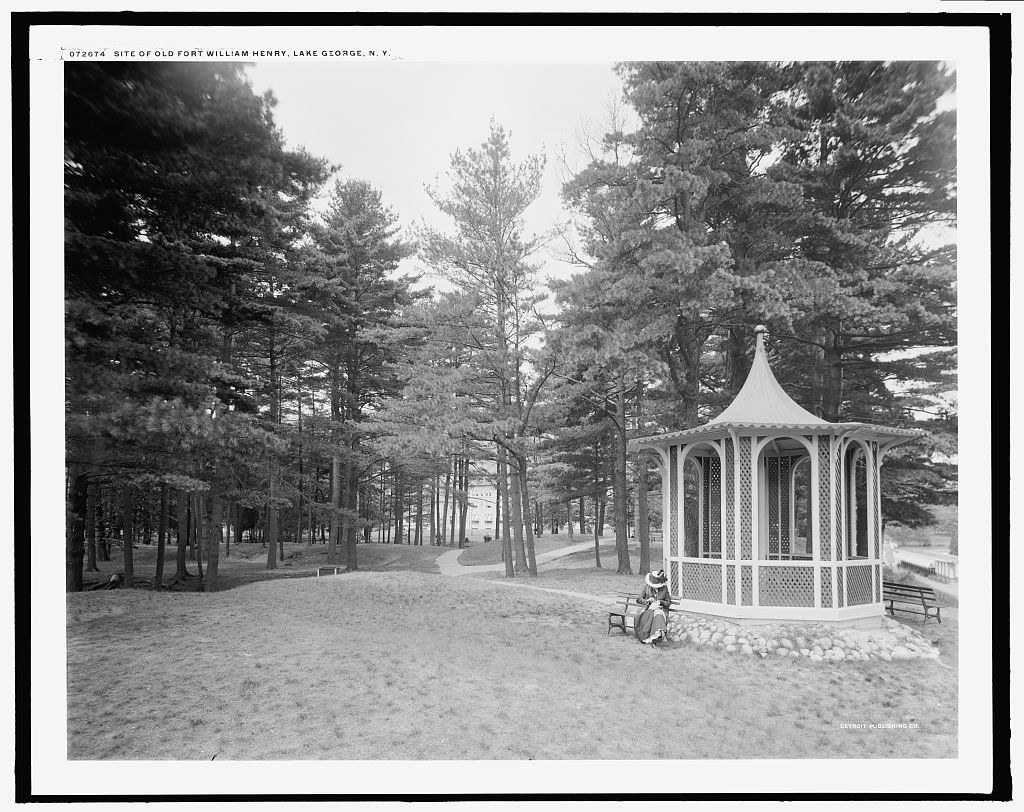
The photograph accompanying this article falls between those two periods. The Library of Congress catalogs it as Site of Old Fort William Henry, Lake George, N.Y., dated between and . Its pavilion, paths and wooded grounds show the site's later appearance, before the reconstruction. It is evidence of that later landscape, with no claim to show the siege itself. [7]
Reading the terms alongside the aftermath
James Fenimore Cooper used the siege in his novel The Last of the Mohicans. The novel and its adaptations belong to the event's later retelling; the surrender articles answer a different question, specifying what the commanders agreed should happen. Institutional histories then trace how that protection failed. Reading those kinds of evidence together preserves the distinction between the military agreement, the violence that followed and the stories told about both. [1] [3]
Sources and archived records
- American Battlefield Trust: Siege of Fort William HenryHistorical account: August 3-9, 1757; full text read November 9, 2026. Checked November 9, 2026.
- New York State DEC: Tour Lake George Battlefield ParkSelf-guided interpretive tour; pages 1-2, battle sequence, military road and memorial. Checked November 9, 2026.
- Lake George Battlefield Park Alliance: Visitor Center Panels, 1757 Siege and Massacre2022 interpretive panels, page 4; camp, siege and departure; downloaded and read November 9, 2026. Checked November 9, 2026.
- Citizen Potawatomi Nation Cultural Heritage Center: Siege of Fort William HenryInstitutional encyclopedia entry; full indexed text read November 9, 2026. Checked November 9, 2026.
- Gillian Burdett, Lake George Examiner: Fort William Henry surrender and Articles of CapitulationAugust 9, 2017 report with complete transcription of nine 1757 articles; read November 9, 2026; not an examination of the signed original. Checked November 9, 2026.
- The Center for Land Use Interpretation: Fort William HenryInterpretive location entry: destruction and twentieth-century reconstruction; read November 9, 2026. Checked November 9, 2026.
- Library of Congress: Site of Old Fort William Henry, Lake George, N.Y.Detroit Publishing Co. photograph, between 1910 and 1920; LCCN 2016812229 / det.4a24327; catalog and image checked November 9, 2026. Checked November 9, 2026.