Roads and buildings
Building Warren County Airport in 1941
Series date: · 4 min read
Prepared and first published . About these dates
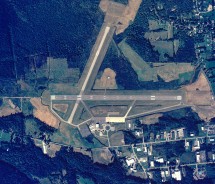
By August 1941, DC-3 aircraft were using new pavement at Warren County Airport. Months earlier, the Queensbury site had required clearing, excavation and fill on wet ground. The surviving construction account describes an airfield being made usable in stages, before the United States entered World War II.
The archived airport history and the county's later historical page preserve the detailed account. An airport inventory published in May 2026 revisits the early sequence. Together they help separate the initial turf strip, the later paving work and the budgets attached to different decisions. [1] [2] [3]
A 1940 proposal and a 1941 building season
The county history dates Colonel Clarence B. Coombs' approach to the Board of Supervisors to September 12, 1940. It places the proposal in planning for national defense and identifies the location between New York City and Montreal as part of the case for the airfield. Plans followed in January 1941. The account describes a north-south runway that had reached 1,900 feet in turf form by March.
This was an early usable surface, not the final paved arrangement.
Treating March as the completion of every runway would collapse several construction stages into one date.
The May 2026 inventory summarizes the same origin story, but its wording about when construction began differs from the older page's description of the March condition. For a detailed chronology, the safest approach is to retain the stated milestones and identify which account supplies each one. The later inventory is a planning document's historical summary, not a new daily construction log.
The ground had to be prepared before it could carry aircraft
On May 16, according to the archived narrative, graders began stripping sod from roughly 55 acres, much of it requiring tree clearance. The account then describes excavation and filling where swampy ground complicated the new runway profiles. Its machinery list includes power shovels, bulldozers and trucks.
That sequence explains why runway length alone gives an incomplete picture of the project. Work had to create a supporting earthwork area before the pavement could perform its job. The source distinguishes a broad prepared runway area from a narrower paved surface. Quoting both widths as if they described the same finished pavement produces a false contradiction.
- Initial strip: a north-south turf runway is described by March 1941.
- Expansion: the runway was extended and a second alignment developed.
- Earthwork: wet-ground excavation and fill established the profiles.
- Surface preparation: rolling and paving followed before the reported August DC-3 use.
The August reference is a practical marker: aircraft were using the pavement. It does not mean that every building and later airport improvement was complete. The account places the caretaker's building and administration-building planning in later years. [1]
Why the historical dollar figures should stay separate
| Figure | How the source describes it | What it does not establish |
|---|---|---|
| $500,000 | Federal construction spending contemplated in the early agreement | A final accounting of every airport expense |
| $10,000 | The county's initial land appropriation | The full cost of all later land and rights |
| $27,000 | A figure attached to the described six-month work period | A substitute for the whole federal program budget |
These are nominal dollars stated in a historical narrative. They describe different scopes and kinds of financial action. Adding them does not produce a documented final project cost, and choosing the smallest figure does not prove that the entire airport was built for that amount.
The same caution applies to the narrative's equivalence between the work and a length of road construction. It helps a reader picture the scale of the operation. It is not an independent quantity survey from which a modern construction estimate can be derived.
The Queensbury airport has its own history
Floyd Bennett Memorial Airport in Warren County is distinct from Floyd Bennett Field in Brooklyn. The shared commemorative name can lead searches toward records of the other airfield. Location, runway references and the responsible county must be checked before an image or date is attached to the Queensbury story.
The archived Bennett biography explains the local name's subject. The airport construction history supplies the building sequence. For a current planning reference, the 2026 inventory labels its historical discussion as section 1.3.4. Those are separate records for a person, a construction project and a later airport assessment.
Sources and archived records
- Airport HistoryHistorical airport construction account. Checked October 23, 2026.
- Airport HistoryCounty airport history; update date not stated. Checked October 23, 2026.
- 2026 Airport Master Plan Update, Interim Report 1May 2026 interim report, section 1.3.4, page 1-3. Checked October 23, 2026.