
Lumber and working waterways
Feeder Canal: How Glens Falls Moved Lumber to Market
Published: · 5 min read
Prepared and first published . About these dates

The Feeder Canal gave Glens Falls lumber a route to market while supplying water to the Champlain Canal. Behind that trade stood a seasonal chain of work: Adirondack trees cut in winter, logs driven down the Hudson River, sorting at the Big Boom and sawing beside the falls. An guide describes how marked logs reached their owners' mills. County archives identify construction claims and repair records. [1] [3] [4]
What the Feeder Canal supplied and carried
A canal feeder supplies water to another canal. Warren County's Canal Papers describe the Glens Falls Feeder Canal's primary purpose as bringing extra Hudson River water to the Champlain Canal during dry summer months. It also carried lumber, lime, bricks and produce toward Lake Champlain, Albany and New York City. Water supply and freight transport were two functions of the same infrastructure. [3]
The National Register nomination for the Glens Falls City Multiple Resource Area dates a building phase to , under engineer James Walker, and the opening of an effective bulk-freight outlet to . Construction continued in stages: the county archive identifies claims associated with the feeder dam in and canal enlargement from through . These dates describe different parts of the project. [1] [3]
S. R. Stoddard's Lake George (Illustrated) and Lake Champlain, eighteenth edition, explains the hydraulic connection. Water held above the feeder dam supplied the Champlain Canal's summit level through the Glens Falls feeder, entering north of Fort Edward and then flowing both north and south. The dam, feeder and larger canal therefore belonged to a connected water system. [4]
From Adirondack cutting grounds to the Hudson River drive
Stoddard's account begins the lumber journey in fall and winter, when cutters worked the companies' timberlands. Logs accumulated along riverbanks or in streambeds until spring freshets provided water to move them. The guide describes driving as beginning about the middle of April and continuing for nearly two months. That is a contemporary description of the seasonal operation, rather than a fixed calendar for every year's weather. [4]
Individual firms brought their logs to a common point on the main river. A mill owners' organization called the "Hudson River Drive" then moved the combined supply downstream, regardless of ownership. Each firm paid a share based on the number of logs it contributed. River transport could thus be organized collectively even though the timber remained the property of different businesses. [4]
How the Big Boom sorted logs for competing mills
Mixed ownership created a sorting problem. The Chapman Museum's logging history dates the Hudson River Boom Association to and places its Big Boom roughly three miles upstream from Glens Falls. Log marks identified ownership. The museum reports approximately 300 such marks in Queensbury. [2]
Stoddard describes floats made from four timbers, joined to neighboring floats by large chains. Portions of the boom could be raised to release logs. Workers recognized company marks and pushed logs for the first mills into channels called "leaders." Logs bound farther downstream passed through the center and were collected at smaller booms. The boom was a holding and distribution system, with separate paths for different destinations. [4]
At Glens Falls, water-powered sawmills converted the arriving timber into lumber. Stoddard describes mills on both sides of the falls and lumber stacked along the river and canal toward the feeder dam. The loose logs of the incoming river drive and the cut lumber loaded for shipment belonged to successive stages of the trade. [1] [4]
Morgan Lumber Company's canal boats and dry dock
The National Register nomination identifies William McEchron and Jones Ordway with the leadership of the Morgan Lumber Company. The firm built and maintained its own fleet of lumber boats on the Feeder Canal. Its shipping operation extended beyond the sawmill to the vessels carrying the finished product. [1]
The same nomination dates the Morgan Lumber Company Dry Dock Site to about . It records work areas and the remains of six canal-boat hulls. Those observations belong to the nomination's survey period. They establish documented archaeological evidence of boat maintenance without promising what a visitor will find on the ground today. [1]
A stereoscopic view of logs beside the falls
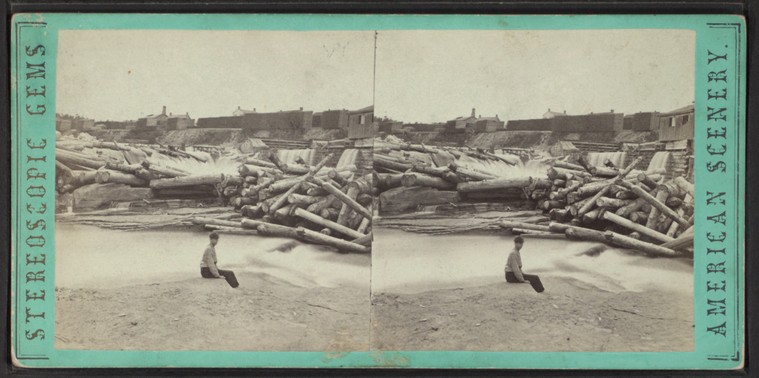
The photograph above is a paired stereoscopic view titled Logs washed over the dam, west side of the bridge, Glens Falls, N.Y. The catalog information supplied with the NYPL image gives an uncertain date range of approximately to . The photographer is unidentified. A seated person appears near piled logs, with mill buildings beyond the water. The scene records the falls area, downstream from the Big Boom discussed here. [5]
Repair records and the later paper industry
The county's Canal Papers finding aid preserves another side of the trade: claims for flooding above the feeder dam, replacement bridge abutments required by widening, and wages and materials for repairs from through . The catalog identifies records to consult. It does not reproduce every claim or payroll. These entries show the maintenance and property issues behind the canal's commercial role. [3]
Wood processing also changed. The Chapman Museum dates Finch, Pruyn & Co.'s pulp mill on the river's north bank, east of the bridge, to . Paper making became another use for the timber reaching Glens Falls. That later industry belongs alongside the earlier sawmills when tracing the city's working waterfront. [2]
For a different water-transport system, the Lake George steamboat account follows passengers transferring between boats and trains. The Hudson River canoe-access history follows the later creation of public recreation sites along the river.
Sources and archived records
- National Register of Historic Places: Glens Falls City Multiple Resource AreaNomination significance section, PDF pages 9 and 12: canal building and navigation, Morgan Lumber Company and dry dock. Survey-period observations, not present-day site conditions. Checked November 23, 2026.
- Chapman Museum: Seneca Ray Stoddard, Logging Perspectives2022 exhibition history: Hudson River Boom Association, log marks and the 1905 Finch, Pruyn pulp mill. Checked November 23, 2026.
- Warren County Records Storage Center and Archives: Canal PapersFinding aid for feeder-dam claims, 1843–1845 enlargement and 1872–1874 repairs; underlying claim and payroll files not reproduced. Checked November 23, 2026.
- S. R. Stoddard: Lake George (Illustrated) and Lake Champlain, eighteenth edition1888 copyright; printed pages 19–20, PDF pages 21–22. Contemporary account of the seasonal drive, Big Boom, mills and feeder-water connection. Checked November 23, 2026.
- NYPL, Robert N. Dennis Collection: Logs washed over the dam, west side of the bridge, Glens Falls, N.Y.Stereoscopic albumen photograph, uncertain catalog dates approximately 1860–1880; digital ID G91F112_006F. NYPL metadata and public-domain status documented on Wikimedia Commons. Checked November 23, 2026.