Winter records
The 1986 Snowstorm in Warren County's DPW Records
Series date: · 3 min read
Prepared and first published . About these dates
The largest entry in the archived DPW snowfall list is 38 inches over January 25-27, 1986. Its three-day date range matters as much as its depth. Treating it as a single-day record would change what the source actually says.
Two surviving pages make the event easier to understand: a selected list of large snowfalls and a season-by-season ledger. Read together, they put the storm inside the winter of 1985-86 and show why a storm total cannot stand in for a monthly or seasonal total. [2] [3]
The 38-inch entry in its season
The seasonal ledger gives January 1986 a total of 47 inches. It lists 111 inches for the whole 1985-86 winter, with 18 storms recorded. The 38-inch event was therefore part of a much longer accounting period. It was neither the January total nor the season total.
| Period | Snowfall, inches | Meaning |
|---|---|---|
| January 25-27, 1986 | 38 | The event identified as that season's greatest fall |
| January 1986 | 47 | All snowfall entered for the month |
| 1985-86 season | 111 | The ledger's whole-season total |
Subtracting the event from the monthly total leaves 9 inches. That is an arithmetic difference between the published figures, not a separate observation about when the remaining snow fell. The ledger does not divide that remainder into dated events. The table also supplies an average fall per storm. That column is a different measure again: it describes the recorded season's total divided across its counted storms. It does not describe the depth encountered on every road or the snow remaining on the ground. [2]
How the March 1993 entry compares
For the winter of 1992-93, the ledger identifies March 13 as the date of a 20-inch greatest fall. It gives March a total of 25.25 inches and the season a total of 96.25 inches. The selected large-snowfall list also includes the March 13 entry.
That supports a limited comparison: the archive records a larger greatest-fall figure for the January 1986 event than for the March 1993 entry. It does not establish that the two figures were collected over identical observation intervals. One date label spans three days; the other names a single date. A reporter would need the original daily observations to resolve the difference.
Nor does the comparison settle which storm caused more disruption. Wind, timing and the condition of roads would require other records. The snowfall tables contain no measure of road closures or plowing hours, and none is inferred here.
A disagreement the archive preserves
The same exercise exposes a problem elsewhere in the collection. The selected largest-snowfall page associates a 28-inch fall with February 16, 1983. The 1982-83 seasonal row instead places its 28-inch greatest fall on January 16. Both entries survive. [2] [3]
Choosing the more plausible date would conceal the disagreement. The useful record is the discrepancy itself, identified by page and row. A daily weather log, a contemporaneous report or the underlying DPW worksheet could settle it; these two summaries alone cannot.
Missing context also limits the geographic claim. The surviving headings identify the county department, but the pages reviewed here do not establish the measurement station and observing procedure for every entry.
A county archive is not automatically a countywide measurement network.
Using the tables without changing their meaning
For a local-history caption, describe the January event as a 38-inch entry for January 25-27, 1986 in the DPW archive. For a weather comparison, keep the observation period beside the number. For an absolute record claim, first establish the station, the daily interval and the comparison dataset.
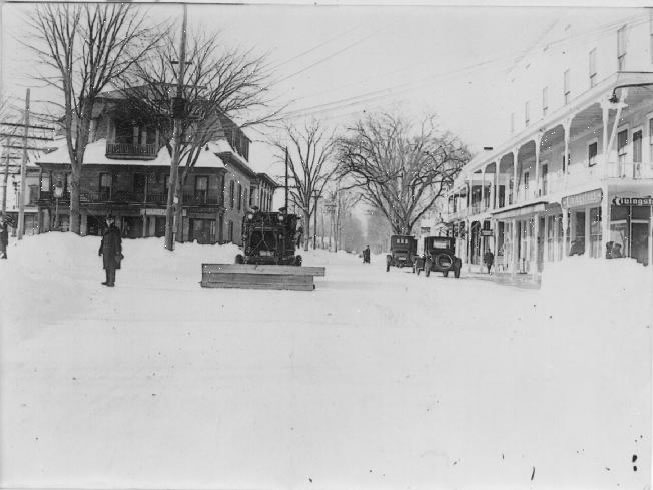
The collection's older snow-removal photograph adds a different kind of evidence: an image of earlier highway work. It is not a photograph of the 1986 storm. Keeping that distinction in the caption lets the image illustrate the department's history without inventing a connection to a later event.
The complete early snowfall table and continuation ledger remain available alongside the selected list. The January 1986 row is the place to start: 38 inches for the named event, 47 for its month and 111 for its season.
Sources and archived records
- Snowfall Record, first tableSeasons 1939/40-1972/73. Checked October 23, 2026.
- Snowfall and Winter Records, continuationHistorical seasonal record, including 1985/86 and 1992/93. Checked October 23, 2026.
- Largest Single SnowfallSelected historical snowfall entries. Checked October 23, 2026.
- 1920s Snow RemovalPage identifies the photograph with 1920s snow removal. Checked October 23, 2026.