

Rainbow Trout: Facts and the Warren County Fish Hatchery
Warren County DPW Archive · Updated and sources reviewed
Rainbow trout, Oncorhynchus mykiss, are coldwater fish in the salmon family. Their pink side stripe and spotted tail help identify them. At the Warren County Fish Hatchery in Warrensburg, New York, rainbow trout are raised for local stocking. This species guide accompanies the archive's original hatchery pages and illustrated fish sheet.
- Scientific name
- Oncorhynchus mykiss
- Family
- Salmonidae, the trout and salmon family
- Local hatchery
- Warren County Fish Hatchery, Warrensburg, New York
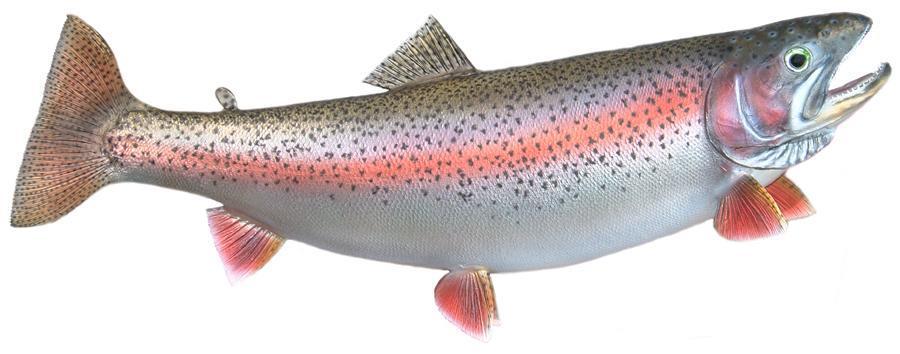
Rainbow trout at the Warren County Fish Hatchery
The county's hatchery is at 145 Echo Lake Road in Warrensburg, along the Hudson River. It began operating in 1914, and Warren County acquired it from New York State in 1982. The county describes a spring stocking program using yearling rainbow trout and domestic brook trout.
Fish arrive as eggs from state and federal hatcheries. After incubation and hatching, they grow in raceways and later move to rearing ponds. The archived hatchery guide explains the facility. For current stocking locations, visitor arrangements and tours, use the official Warren County Fish Hatchery page.
How to identify a rainbow trout
Look for small dark spots across the body and tail, a pink or reddish stripe along the side and a back that ranges from blue-green to olive. The small fleshy adipose fin sits between the dorsal fin and tail. Color changes with habitat, age and spawning condition, so use several features together. FAO's species profile describes these features.
Young fish can show vertical parr marks before developing the adult appearance. Spawning males often have stronger colors. Alaska's fisheries biologists describe these age and maturity differences.
| Fish | Useful identification marks |
|---|---|
| Rainbow trout | Small black spots, including a heavily spotted tail; adults commonly show a pink side stripe. |
| Brown trout | Golden-brown body, dark spots often surrounded by pale halos; usually few or no spots on the tail. |
| Brook trout | Red spots with bluish halos and white leading edges on the lower fins. |
The Pennsylvania Fish and Boat Commission identification sheet (PDF) illustrates these differences. It also shows golden rainbow trout, often called palomino trout, with yellow or orange bodies. That color form can lack the familiar dark spotting.
Scientific name, redband trout and steelhead
Oncorhynchus mykiss is the accepted scientific name. ITIS places the species in Salmonidae and lists coastal rainbow trout, O. m. irideus, and Columbia River redband trout, O. m. gairdnerii, among its subspecies. Its synonyms include the older name Salmo mykiss.
Steelhead and resident rainbow trout belong to the same species. The ocean-going form hatches in freshwater, migrates to sea and returns to freshwater to spawn. A rainbow trout can also spend its whole life in freshwater. The U.S. Fish and Wildlife Service species account explains these different life histories.
In the Great Lakes, lake-run rainbow trout that spawn in streams are also called steelhead, as the NYSDEC fish guide (PDF) notes. A silvery appearance alone does not establish a fish's migration history.
Hatchery strains are another distinction. FAO describes selective breeding and the production of sterile triploid females in rainbow trout aquaculture. A particular stocking program's strain and reproductive status must be checked with that program.
Native range, New York waters and habitat
The native range includes Pacific drainages of western North America. Stocking has spread rainbow trout far beyond that range. NYSDEC dates their introduction to New York to the 1870s and describes populations in streams, rivers, lakes and ponds.
Rainbow trout need cool, clean water with sufficient dissolved oxygen. Maine's fisheries department gives a preferred water-temperature range of 55 to 68°F, about 13 to 20°C. Conditions vary with the fish's life stage and the waterbody. A preferred range is not a guarantee of survival at every temperature.
In flowing water, riffles and runs provide feeding habitat. Lake-dwelling fish use different depths as food and water conditions change. NYSDEC warns that elevated summer stream temperatures can stress trout and advises avoiding catch-and-release fishing during those conditions.
What do rainbow trout eat?
Aquatic insects are an important food source. Rainbow trout also eat land insects that fall into the water, crustaceans and other small animals. Their diet changes as they grow: small fish feed on small prey, while larger trout can take fish and fish eggs. Available food varies by season and location.
The Maine species account describes this opportunistic feeding. It helps explain why a trout's feeding position can change as prey becomes available near the surface or deeper in the water.
Spawning and the rainbow trout life cycle
Wild rainbow trout generally spawn in spring. A female prepares a gravel nest, called a redd, where eggs are deposited and fertilized. Timing and incubation depend on local water conditions. Alaska's species account describes this process. Its regional spawning dates should not be treated as a Warren County calendar.
- Egg: the embryo develops inside the egg. Its eyes become visible during the eyed-egg stage.
- Alevin or sac fry: the newly hatched fish is nourished by its attached yolk sac.
- Fry: after the yolk is absorbed, the young fish begins feeding.
- Fingerling and yearling: the juvenile grows. A yearling is about one year old.
- Adult: a mature fish can reproduce when suitable spawning conditions are available.
NYSDEC's fish guide explains the early stages. Managed rearing provides conditions for egg development and growth. Warren County's spring yearling release is one local point in that longer life cycle.
Rainbow trout and steelhead can survive spawning and reproduce again. Their growth and age at maturity vary with food, water temperature, population density and genetics, so there is no single growth rate that applies to every stream, lake or hatchery.
Size, weight and lifespan depend on the population
Stream fish and lake or ocean migrants can reach very different sizes. As a regional example, Maine reports that anglers commonly catch rainbow trout 8 to 16 inches long. That is a catch-size range in Maine, rather than a species-wide adult average.
For steelhead, NOAA Fisheries gives a usual lifespan of 5 to 8 years, with some living up to 11 years. Those figures describe steelhead and should retain that context when compared with resident freshwater trout.
The county's original species sheet includes a New York record dated 2004 and a world record dated 2007. They are preserved as historical entries in the linked PDF. This updated page does not present those old records as current records.
Conservation and fish health
A fish's conservation status depends on the population and place. NOAA identifies protected West Coast steelhead populations and threats including habitat loss, migration barriers and changing water conditions. That regional conservation context is separate from New York's introduced and stocked rainbow trout fisheries.
Rainbow trout are susceptible to whirling disease, caused by the parasite Myxobolus cerebralis. The North Carolina Wildlife Resources Commission explains that juveniles are especially vulnerable because their skeletons are still developing. Its guidance includes cleaning fishing equipment and avoiding the transfer of live fish between waterbodies.